AI Tools for Drafting 8-K Current Reports and Press Releases
AI tools are now essential for meeting tight SEC filing deadlines.

An 8-K has a four-business-day filing deadline, no extension mechanism, and no forgiveness for getting the language wrong. That combination is why AI drafting tools have moved from novelty to necessity in corporate disclosure work, and why the tools have to be understood by function before anyone touches a live filing with one. Most 8-K items carry that four-day clock, with only narrow carve-outs: a 71-day grace period for Item 9.01 acquisition financials, and a national security delay available for Item 1.05 cybersecurity disclosures. The SEC estimates the average burden per 8-K at 6.31 hours. That figure reflects the multiple functions that all have to align on the same document before the clock runs out.
The cybersecurity wrinkle makes the four-day window harder to meet, not easier. Item 1.05's four-day window starts at the moment a company determines an incident is material. That means the internal investigation, the forensic work, and the legal counsel engagement all happen before the countdown even begins, and by the time drafting starts, the clock is already the least flexible part of the process.
What the SEC's AI Build-Out Means for Disclosure Drafting
The SEC isn't watching AI adoption from the sidelines. It built an internal AI Task Force in August 2025, gave it a Chief AI Officer, and structured it to run across divisions rather than sit inside one office as a pilot project. Building an internal AI Task Force in August 2025, giving it a Chief AI Officer, and structuring it to run across divisions rather than sit inside one office as a pilot project means this isn't a temporary working group testing a tool, it's infrastructure the agency intends to keep.
Part of that infrastructure includes AI used to summarize submitted filings for staff doing triage work. Practically, that means the examiners reading a company's 8-K are getting faster at spotting the things a manual reviewer might miss on a first pass: language that shifted year over year without explanation, disclosure that reads oddly next to what peer companies in the same sector are saying, wording that doesn't match the risk factors filed twelve months earlier. The Division of Examinations named AI a priority area for Fiscal Year 2026, and said directly that it will review filings for the accuracy of a registrant's own representations about its AI capabilities. In other words: the SEC is using AI partly to check whether companies are lying about their AI.
The disclosure landscape has moved just as fast. In 2023, 12% of S&P 500 companies disclosed at least one material AI risk. By 2025, that number hit 72%, a sixfold jump in two years. Companies that once treated AI as an optional footnote are now treating it as a line item examiners expect to see, and the SEC's own tooling means that expectation is backed by faster detection than it used to be.
The AI washing enforcement risk that 8-K and press release drafters must keep front of mind
Since 2021, the SEC has sent 92 separate AI-related comment letters to 56 companies, and brought two formal AI washing enforcement actions. Two sounds small next to 92, but enforcement actions are the tip of a much larger iceberg of comment-letter pressure, and the number that matters most is the second one: two is enough to establish precedent.
A restaurant technology company. settlement did exactly that. Presto, formerly a Nasdaq-listed restaurant technology company, overstated its AI capabilities in disclosures, and the SEC went after it under existing anti-fraud statutes. No new AI-specific rule was needed to bring the case, which tells drafting teams something important: the exposure already exists under current law. Waiting for a bespoke AI disclosure rule to start being careful is not a defensible position.
That said, the rulemaking landscape may be shifting anyway. A formal petition, File No. 4-882, was submitted in February 2026 requesting mandatory, standardized AI governance and risk management disclosures. If adopted, it would move the field from voluntary disclosure judgment calls to a fixed template, similar to what happened with cybersecurity disclosure requirements a few years earlier.
For drafting teams, AI washing risk tends to cluster in three specific spots. Business descriptions that describe AI as central to the company's value proposition without describing what's actually been deployed. Risk factor sections that list generic AI risks copied from a template, without reflecting how the company's models are actually used in production. MD&A language that credits AI for cost savings or margin improvement without a documented, traceable basis for that claim. All three are places where a comment letter or an enforcement referral can start, and all three are places where an AI drafting tool can, ironically, introduce the exact language that gets flagged if nobody checks the claim against reality first.
The critical distinction between filing preparation tools and filing research tools
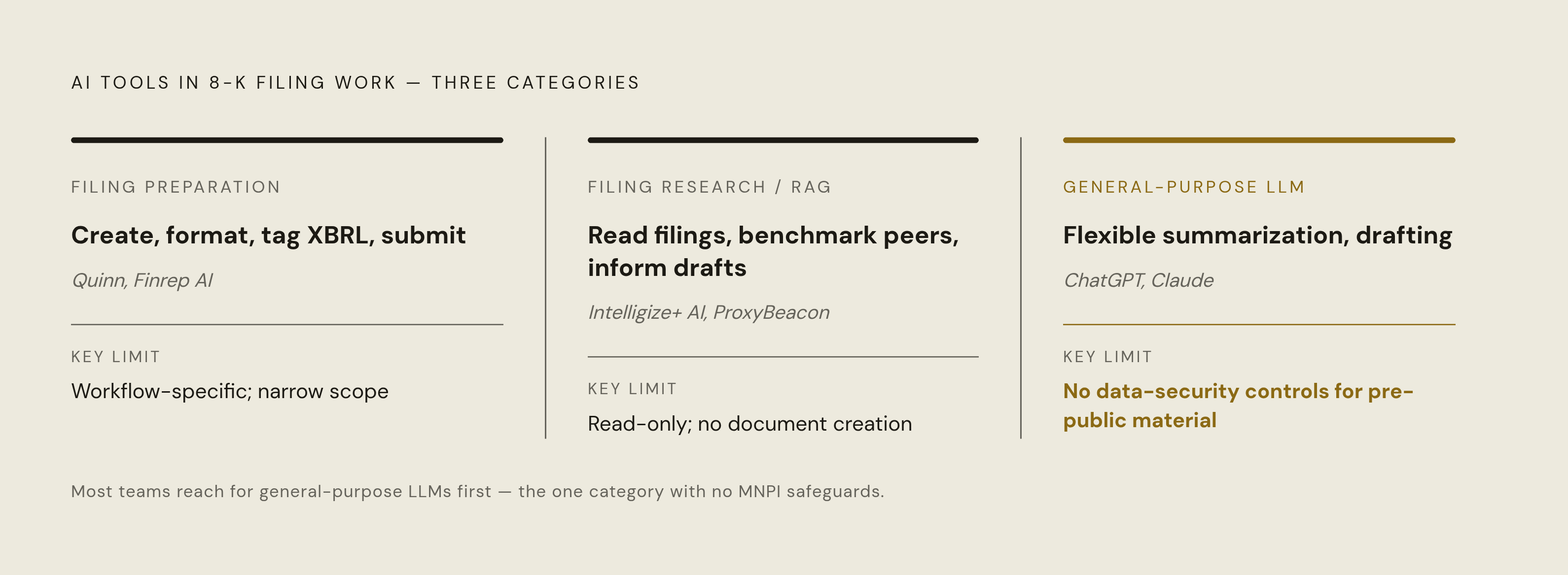
The single most common mistake in this space is treating "AI for SEC filings" as one category. It isn't one category, because that's the single most common mistake in this space. Filing research tools read and extract information from filings that already exist, comparing a company's disclosure against its peers or against its own prior filings. Filing preparation tools do something structurally different: they create, format, route for review, tag in XBRL, and submit the document itself.
Confusing the two leads teams to buy a research subscription expecting it to draft an 8-K, or to buy a drafting platform expecting it to benchmark disclosure language against competitors. Neither works that way. Preparation platforms like Toppan Merrill's Quinn handle the mechanics of document creation and the EDGAR submission itself. Research platforms like EDGAR-native retrieval-augmented generation (RAG) tools feed intelligence into a draft rather than producing the draft itself, supporting work like peer comparison and disclosure benchmarking.
General-purpose large language models, ChatGPT and Claude among them, sit in a distinct, third bucket. They're fast, flexible, and genuinely useful for summarizing an uploaded document or drafting a rough passage. But they carry no live connection to EDGAR, no compliance-grade accuracy guarantee, and none of the data security controls a company needs when the document in question contains material non-public information before it's been filed. Using a consumer chatbot to draft language around an unfiled 8-K is a data handling decision as much as a drafting one, and it deserves to be treated with that level of seriousness.
Filing preparation platforms built for the 8-K drafting workflow
Toppan Merrill's Quinn platform launched broadly on December 22, 2025, positioned as a next-generation SaaS tool for legal and corporate teams producing complex regulatory disclosure documents. It expanded on July 7, 2026 to cover proxy statements and management information circulars as well.
Quinn's feature set maps closely onto the actual pain points of 8-K drafting. "Smart Format" generates a fully styled, brand-compliant document in a single click, cutting out the formatting back-and-forth that eats hours in a rushed filing. "Smart Track" keeps a complete audit trail of every change made to the document, which matters enormously when legal, finance, and communications are all editing the same file under deadline pressure and need to know exactly who changed what and when. "Smart Content" links common content across a shared library, reducing the risk that the 8-K body says one thing and the attached press release says something slightly different, a small inconsistency that can look, from the outside, like sloppy disclosure practice at best and something worse at worst. On the security side, Quinn runs SSO authentication, holds SOC 2 Type 1 attestation, and carries ISO 27001 certification, all relevant for any team handling material information before it's public.
Finrep AI takes a different approach, offering AI agents deployable at each stage of the 10-K, 10-Q, and 8-K process, with all three treated as co-equal workflows rather than 8-K support bolted onto a 10-K product. Finrep's agents are designed to automate the tedious parts of periodic filing work and flag language that warrants a human judgment call rather than a mechanical update. Roll-forward work is where transcription errors quietly creep into filings, and tooling that surfaces discretionary language rather than silently rewriting it addresses the actual problem instead of a simpler adjacent one. Finrep is built for reporting teams that already know the workflow cold, not for someone drafting a first 8-K from scratch.
Writer, an enterprise AI platform, handles a different piece of the puzzle: press release creation and distribution rather than the 8-K itself. It supports template libraries stocked with current company data, an approved quote library so executives aren't misquoted or quoted out of context, and multiple versions of the same release built for different distribution channels. For companies that file 8-Ks often and attach a press release as an exhibit each time, the value is consistency at scale, keeping brand voice intact across dozens of releases a year rather than drifting release by release.
None of these platforms removes the need for a human to check the numbers. Financial figure validation, legal accuracy review, and consistency checks against prior disclosures still belong to a person. What these tools compress is the drafting cycle, the hours spent formatting and reconciling comments. They do not compress, and were never built to compress, the review cycle that shows whether the filing is actually correct.
Research and benchmarking platforms that inform what goes into the 8-K
Intelligize+ AI, through its Protégé feature, works off proprietary tagging and deep filtering of SEC filings, supporting multi-turn conversational research that keeps context intact across a whole research session rather than resetting with every query. It can trend-analyze across 10-K and 10-Q filings, compare how different companies disclosed similar 8-K events, and benchmark proxy statement language across a peer group. The output includes comparative tables, organized summaries, and grounded first-draft language, all meant to support internal review rather than go straight into a filing. Every output links back to the specific filing section it's drawn from, which is what "traceable" means in a compliance context: a reviewer can check the claim against the source in seconds rather than taking the tool's word for it. It also runs in a privately hosted environment, addressing the data security question that comes up any time pre-public material touches a third-party platform.
Filing Navigator AI, from AI Trailblazer LLC, is available through the Microsoft Azure Marketplace, which puts it within reach of mid-market teams that don't have a dedicated data science group standing by. It's built on a RAG architecture using Cohere's search engine paired with a reranker model that reads query intent dynamically, and it's fine-tuned specifically for financial services, tuned to EDGAR filing language and the specialized terminology that shows up in that domain. The vendor claims this doubles accuracy in financial data extraction compared to a generic natural language processing tool, a figure to treat as a vendor claim rather than an independently audited one, though the underlying logic (domain-specific tuning beats general-purpose models on domain-specific text) holds up as a general pattern across the RAG tooling space. Its output can be used by teams building a benchmarking table that ends up informing the actual language of an 8-K.
ProxyBeacon, built by Tumelo, ingests DEF 14As, 10-Ks, and 8-Ks for a defined universe of issuers, with new filings available for research within an hour of SEC publication. It uses semantic vector databases for meaning-based retrieval rather than keyword matching, and every output carries an explicit citation back to the filing it came from. Tumelo's own internal benchmarking found general-purpose LLMs scoring around 84% on proxy statement analysis tasks, a number the firm calls insufficient for work where an error can affect a vote, an engagement position, or a client report. That's a useful data point beyond ProxyBeacon itself: it's a concrete illustration of the accuracy gap between a general-purpose model and a domain-specific RAG platform, in a context where the cost of being wrong isn't hypothetical.
The sequencing matters as much as the tool choice. Research platforms exist to tell a company what peers are disclosing and what the SEC has already pushed back on elsewhere. That intelligence belongs in the drafting decision before a preparation tool ever touches the document, not after.
AI tools purpose-built for press release drafting alongside 8-K filings
Adoption in communications work is already close to universal. 80% of PR professionals have adopted AI tools in some form, and 88% of businesses report using AI in at least one business function. A team still drafting press releases entirely by hand is working at a structural speed disadvantage against that backdrop, whatever the merits of the final language.
Cost is part of the calculation too. Hiring a PR agency to draft a single press release typically runs from several hundred dollars to a few thousand, depending on scope and revision rounds. Dedicated AI press release tools, by contrast, run roughly $13 to $249 a month depending on feature set and volume, a gap that makes the tooling an easy budget decision even before quality enters the conversation.
Notified's AI Press Release Optimizer, part of its Content OS and available to GlobeNewswire clients at no extra charge starting March 2026, is grounded in the company's SOAR Content Framework, offering structured recommendations on clarity, structure, authority, and quotability. It also addresses a problem that didn't exist in this form a few years ago: as AI search tools and answer engines increasingly mediate how information gets discovered, the tool is built specifically to improve how visible a release is to those systems, while also sharpening the language for the human journalists still deciding whether to run the story. Authors can accept, edit, or ignore any suggestion, which keeps the release in the company's actual voice rather than flattening it into something generic.
PR Newswire's Press Release Score Tool works differently, grading a draft release on a scale from "Poor" to "Great" using historical performance data, industry benchmarks, and generative AI analysis. It checks headlines, quotes, structure, calls to action, and the overall news angle, then returns specific feedback on what to fix. It functions as a quality gate inside the PR Newswire distribution workflow rather than a drafting tool in its own right, most useful for teams already distributing through that wire.
Hallucination Risk in 8-K and Press Release Content
The scale of the hallucination problem in legal and regulatory writing is documented. More than 2,000 cases of AI-driven hallucinations in legal contexts have been recorded since mid-2023, with more than 500 of those logged in 2025 alone. Thomson Reuters documented 22 separate cases in July 2025 where a court or an opposing party caught a filing citing cases that simply do not exist. That's not a rounding error in a niche corner of legal practice, and it's a pattern serious enough that courts have started building it into their expectations of what to check for.
Among practitioners who say generative AI shouldn't be part of their daily work, 40% cite accuracy and reliability as the top reason, nearly double the next most common concern. That skepticism tracks with where the actual risk concentrates in 8-K and press release drafting: financial figures pulled or restated by a model without a verified source, quotes attributed to executives that were never actually said in that form, and forward-looking language that drifts from cautious to promotional in a way that starts to resemble the exact AI washing pattern the SEC has already brought enforcement action over. None of the tools covered above eliminate that risk on their own. What separates the platforms built for this workflow from a general-purpose chatbot is traceability, the ability to check every generated claim against a cited source before it goes anywhere near EDGAR. That check is still a human's job, and under a four-day clock with no extension, it may be the most important four minutes in the entire process.