Handling Hostile Analyst Questions on Small-Cap Earnings Calls
Techniques for staying composed when analysts press hard on earnings calls.
Small-cap earnings calls carry a specific kind of danger that large-cap calls mostly don't: thin analyst coverage means every skeptical question lands with outsized weight, and a single bad exchange can define how the stock trades for weeks. Surviving a hostile question on one of these calls isn't about charm or evasion. It comes down to a specific set of techniques for acknowledging pressure, holding the frame of the answer, and getting through the moment without looking defensive.
What builds analyst skepticism before the call begins
Skepticism doesn't start when the first hostile question gets asked. It starts months earlier, embedded in the track record.
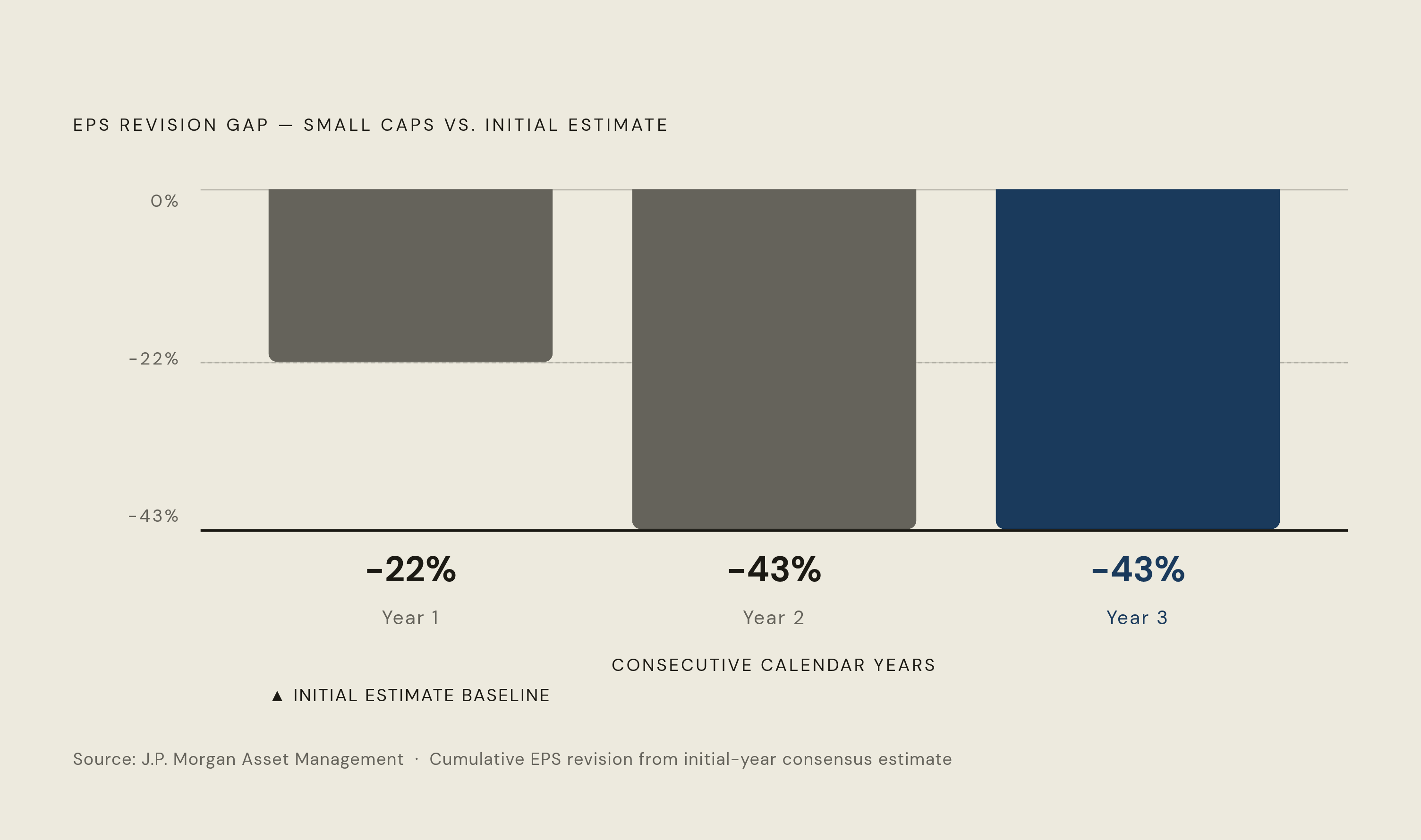
J.P. J.P. Morgan Asset Management's data on small-cap earnings shows a structural pattern: over the past three calendar years, final EPS outcomes for small caps were revised down by a cumulative 22%, 40%, and 43% from initial estimates. That's a structural pattern of over-optimism followed by disappointment, repeated year after year. That's a structural pattern of over-optimism followed by disappointment, repeated year after year, and it means analysts walk into every call already discounting whatever guidance management is about to offer. They've been burned before, often by the same company.
Macro conditions have piled onto that baseline distrust. Tariffs came up in 43% of Q1 2025 earnings calls, a 190% jump from Q4 2024, and small-cap management teams who couldn't give a clean, quantified answer on tariff exposure saw a noticeable spike in hostile follow-up questions. Vague answers on a topic every analyst is already tracking read as either unpreparedness or evasion, and neither impression is one a management team can afford heading into Q&A.
Then there's the newer wrinkle: short-seller research posted publicly in the days before a call. Once a negative report is public, the earnings Q&A shifts from a forum for discussing the quarter to the venue where analysts try to extract an on-the-record denial, or, just as often, an admission. Management walks in already on defense, whether or not anyone on the call mentions the report by name.
Why Q&A is where credibility is won or lost
Prepared remarks are rehearsed, scripted, and reviewed by legal. Nobody learns much from them. Q&A is unscripted, and that is why it's where investors actually judge whether management knows the business cold or is just reciting talking points.
A 2025 study in the Financial Review introduced a measure called "tone distance," the variance in language and confidence between different executives answering questions on the same call. The finding: greater tone distance is associated with worse market outcomes around the earnings announcement, even after controlling for the actual earnings surprise and the overall tone of the call. In plain terms, it doesn't just matter what gets said. It matters whether the CEO and CFO sound like they're reading from the same page.
An open-ended Q&A with no natural stopping point gives a persistent hostile questioner unlimited chances to keep circling back. IR teams spend weeks stress-testing disclosure language before a call, choosing every word with care. Then an analyst asks about "meaningful deterioration in enterprise demand," and the CFO, trying to be transparent, confirms it in plain language. Management walks away thinking that was a moment of candor. Trading algorithms parsing the transcript in real time read it as a sell signal. Both readings are correct. That's the tension Q&A lives inside.
The same research, building on earlier work by Larcker and Zakolyukina, found something that cuts the other way too: excessively positive tone under questioning predicts a higher likelihood of future financial restatement. Overcorrecting into forced optimism when an analyst is pushing hard isn't a safe alternative to candor. Sophisticated analysts read over-positive spin as its own red flag.
The four categories of hostile question and what each is trying to accomplish
Not every hostile question wants the same thing, and treating them all identically is a common mistake. There are four categories, because each has a different objective and a different correct response.
Legitimate analytical pushback is the most common. Analysts track guidance language quarter over quarter, and any inconsistency, a walked-back number, a metric that quietly disappeared from the slide deck, becomes the trigger for a hard question. These analysts want precision and consistency, nothing more exotic than that. They can be satisfied. The correct response is specificity.
Short-seller-adjacent questioning looks different. Activist short sellers do deep, often adversarial research, and if they've already published a negative report, the Q&A becomes the venue for generating an on-the-record denial or forcing a damaging admission. Short attacks create uncertainty, damage investor perception of management, the board, and the company, and pull executive attention away from running the business, regardless of whether the underlying claims hold up. The tell is in the framing: a genuine question asks something. A short-seller-adjacent question states a premise first, "given the concerns that have been raised about X," and only then asks. That framing is doing work on its own, independent of whatever follows the comma.
Activist investor signaling is quieter and easier to miss. Small-cap activism draws far less press than large-cap activist campaigns, so a question on the Q&A line may be the public surfacing of a grievance that's been building privately for months. Small-cap boards tend to run smaller, with less specialized expertise spread across the table, and that can leave management underprepared for how sophisticated a governance challenge actually is. The tell here is subject matter: questions about capital allocation, board composition, or governance structure, rather than anything operational.
Macro-risk frustration is the fourth category, and it's less about the company specifically than about management's failure to address a known sector-wide risk clearly enough, tariffs, rate exposure, supply chain fragility. It matters more for small caps than it might seem: close to 70% of small-cap companies generate more than 90% of their sales domestically, which means macro shocks hit this universe with less room to hide behind geographic diversification. The tell is that the question cites an industry peer or a macro data point rather than anything specific to the company on the call.
Pre-call preparation as the foundation all live techniques depend on
None of the in-the-moment techniques work without groundwork laid well before the call starts. Building the question bank is step one: go through the quarter's results, compile the likely questions including anything carried over from the prior call that never got fully resolved, and survey sell-side analysts ahead of time to get a read on what's actually on their minds.
Profiling the questioners matters just as much as the topics. Knowing an analyst's investing history, the comparable positions they hold in similar companies, and where their attention has drifted in past calls is how a management team figures out, in advance, who's likely to come in hostile and why. That's preparation matched to the level of scrutiny the call is actually going to get. That's just preparation matched to the level of scrutiny the call is actually going to get.
Answers should be built around key messages and proof points organized by topic, not memorized line-by-line scripts. Bullets, not prose. That structure gives an executive enough of a scaffold to stay on message without sounding like they're reading off a card when the pressure hits.
Guidance deserves its own stress test, done early in the prep cycle rather than the night before. What's actually changed since last quarter's guidance. Whether that change is significant enough to warrant a revision. And, most importantly, what the honest answer is if an analyst asks directly whether guidance is still credible. Skipping this step is how management teams end up improvising an answer to whether guidance is still credible, the single thing they most needed to have already worked out.
In-the-moment techniques for acknowledging pressure without conceding the frame
Acknowledge before answering. Validating that a question touches on a real concern, without agreeing to whatever unfavorable premise it's built on, lowers the temperature in the room and signals command of the material rather than defensiveness. It costs nothing and buys a beat of composure.
Separate the premise from the question itself. Hostile questions often smuggle in a framing that management shouldn't accept wholesale, "given that margins have clearly deteriorated," when the real picture is more mixed. Address the framing directly, then answer what the honest response actually is. Skipping that separation means implicitly accepting a premise that may not hold up.
Bridging language earns its place here too. Answer what's asked, completely but without padding, then bridge back to the company's actual long-term story. That's context, not spin. It's context an analyst asking a narrow question may not have front of mind, and it's the difference between sounding evasive and sounding like someone who knows where the business is actually headed.
Tonal alignment between CEO and CFO is a live risk, not a nice-to-have. Given the tone-distance finding from the Financial Review study, a CFO who hedges on something the CEO just said with confidence is itself a signal the market will price, independent of whatever the actual answer was. Staying aligned in real time, not just in the prep room the day before, has to be treated as an ongoing discipline through the whole call.
Managing the room: call structure, sequencing, and moderator discipline
Who gets called on first is a lever. It's a lever. Recognizing supportive or neutral analysts early in Q&A sets a constructive frame for the rest of the session, so that a hostile question, when it lands, reads as an outlier rather than the dominant narrative of the call.
Time discipline shapes how much control management retains over the session. An open-ended Q&A with no natural stopping point gives a persistent hostile questioner unlimited chances to keep circling back. Announcing a time limit or a question cap at the start of Q&A isn't a defensive move, it's a legitimate structural tool that gives the moderator cover to move the call along when needed.
Follow-up questions deserve particular attention, because many hostile questioners use the follow-up to re-litigate an answer they didn't like the first time. The discipline here is to answer the follow-up as its own question, on its own terms, rather than getting pulled into re-answering the original one a second and third time.
On small-cap calls, the operator is frequently the only person actually managing traffic, and that's often not enough. someone beyond the operator alone should be positioned to redirect the flow of the call when needed.
Handling the hours and days after a hostile exchange lands badly
The transcript outlives the call. Earnings call transcripts persist in the written record, so a damaging exchange that goes uncorrected compounds over the following days rather than fading.
The press release and the 8-K aren't the right tools for repair work. A targeted one-on-one follow-up call to the specific analyst involved, clarifying a misstatement or filling in context that got lost in the pressure of the moment, preserves the relationship without dragging the issue back into public view a second time.
One bad exchange is recoverable. A pattern across multiple quarters, inconsistent guidance, shifting tone, repeated deflection under pressure, is a different problem entirely, and it's one no single-call tactic is going to fix. At that point the issue isn't Q&A technique, it's whether management has been straight with the market over time.
Proactive IR between quarters carries so much weight for companies without full-time IR staff because it happens outside the pressure of the live call. Year-round contact with analysts means skeptical questions get raised and addressed privately, long before the live call, which lowers the odds of ambush and, over time, does more to protect credibility than any technique deployed live on the call itself.